



Awards
NEBS is committed to supporting botanical research in New England and floristically related regions. We have financial awards available for students, avocational and professional botanists, academic faculty, and Rhodora contributors, as well as scholarships for students to attend NEBS events. If you have questions about eligibility, please feel welcome to contact the Committee Chair of the award opportunity you are interested in or reach out to coordinator@rhodora.org.
Junior Faculty Award
Established by the New England Botanical Society in 2019, the Junior Faculty Award supports the developing research programs of early career academic faculty with work focused on botanical, ecological, biogeographical, genetic, or systematic aspects of plants in the New England flora. Early career candidates are those who are in their first 5 years as a new academic member at a post-secondary teaching institution in New England, who are teaching botanically related courses, and who are establishing or expanding a research program. For the purposes of this award, “botanical” study systems can include vascular plants, non-vascular plants, algae, fungi, and lichens.
Applicants do not need to be a member of our organization to apply for this award.
The objective of NEBS in offering the Junior Faculty Award is to support new members of the academic community in New England and to encourage innovative botanical research on the flora of the region. The award grants are intended to support research, including botanical surveys and studies, ecological experiments in field or greenhouse settings, molecular and phylogenetic lab work, applied and conservation-oriented research, and herbarium-based studies, or similar projects. This research may be newly proposed or in the early stages of implementation. Please note that this award may not be given every year, but only in years where applicants meet all the eligibility requirements.
Click here for a postcard that can be downloaded to share.
Application Instructions
Project Requirements: The research must advance our knowledge of plants that occur in the New England flora. Studies with research taking place primarily at New England study sites and/or using plant material from New England populations or herbaria will be favored. Projects that include opportunities for mentoring undergraduate or graduate students will also be viewed favorably. Notably, while the project proposed might represent the first stage of longer-term efforts in a study system, the proposed work should result in a complete project, experiment, or study within one year of the award.
Types of Expenses Eligible for Support: Costs associated with conducting field, lab, greenhouse, and/or herbarium-based research are eligible for funding. Travel and lodging expenses associated with the research are also eligible, as are supplies and equipment associated with the proposed work. Modest stipends to support student involvement in projects will also be considered.
Eligibility: The Junior Faculty Award is open to early career faculty members within the first five years of their employment at the college or university where they are based in the New England region. Applicants should have completed graduate training (typically Ph.D.) in a plant-related field of biology and have a record of academic achievement (e.g., peer-reviewed publication).
Amount of Award: Applicants may request up to $5,000, but a full budget for a project must be included. If total costs exceed $5,000, indicate other sources of funding available to or being sought by the applicant to ensure project launch and feasibility in the coming year.
How to Apply: Please submit a proposal describing the research to be conducted, which includes:
- Title page with proposal title, applicant’s name, academic address, phone, and e-mail address.
- Body of the proposal of no more than three pages text (For a proposal to be successful, the topic and research questions must be clearly described, the methods justified, and the results achievable within defined time limits.)
- List of literature citations relevant to the project
- Itemized budget, including brief justification for each item
- Timeline for completion of the proposed work (typically 1 year, although research hinging on growing season access to study sites or focal species will be considered for ~1.5 year timeline over two summers)
- Deliverables including plans for disseminating results more broadly
- Curriculum vitae
The application period opens on December 1 and closes on February 1. Applicants will be notified as to the success of their proposals by March 1.
Upon accepting the award, recipients are required to submit an abstract describing the planned research in MS Word format for posting on the NEBS website. A final report, including an updated abstract, is required at the completion of the project on the date specified in the award letter.
Please submit your complete proposal via email to the Junior Faculty Award committee at: JuniorFacultyAward@rhodora.org. The complete application should be sent as an email attachment, preferably in PDF format.
If you have questions regarding eligibility, budget, and scope, please email JuniorFacultyAward@rhodora.org.
PLEASE NOTE: Winners of awards amounting to $600 or more will be required to submit IRS Form W-9 Request for Taxpayer Identification Number (provided by our treasurer) before award checks will be issued. In these cases a Form 1099 will be issued the following January to the recipient reporting the amount as an award (as required by law). Awards will ONLY be paid to the award recipients and NOT to any third party (such as colleges, universities, research institutions, employers, family members, etc.). For winners who are not United States residents, nonrefundable tax withholding of 30% will generally apply unless reduced or exempted by tax treaty.
Les Mehrhoff Botanical Research Award
Established by the New England Botanical Society in memory of renowned botanist, NEBS Herbarium Curator, and long-time supporter of the New England Botanical Club, Dr. Leslie J. Mehrhoff, the award supports botanical endeavors of the sort that Les championed: field studies, herbarium, library, and archival research. The objective of NEBS in offering the award is to add to our understanding of the flora of New England and floristically related regions. The selection committee favors projects for which traditional funding (such as academic grants and in-house agency support) is difficult to secure. NEBS wishes to thank the Hollis Declan Leverett Memorial Fund, Bank of America, N.A., Trustee, for their support of this award.
Applicants do not need to be a member of our organization to apply for this award.
Click here for a postcard that can be downloaded to share.
Application Instructions
Project Requirements: The research must advance our knowledge of plants that occur in northeastern North America, especially the New England region. Work of a broader scope that is pertinent to New England will also be considered. For purposes of the award, “plants” include vascular plants, nonvascular plants, algae, fungi, and lichens.
Types of Expenses Eligible for Support: Field, herbarium, library, and lab work are eligible for funding. Travel and living expenses associated with the research are eligible, as are supplies and equipment associated with field or lab work. Moderate stipends to help cover time spent on projects will be considered.
Eligibility: The award is open to anyone with background and experience sufficient to accomplish the proposed work. A central theme of the award is to encourage researchers to pursue lines of inquiry that might not otherwise be undertaken. Thus, awards may not be used to augment budgets of established research projects. Projects for which funding is difficult to secure from traditional sources are favored. Graduate students are eligible for projects outside the scope of their primary research (or prior to deciding on a project); more advanced graduate students are encouraged to apply for the NEBS Graduate Student Research Award. Advanced undergraduates are also eligible with a letter of support from their faculty advisor.
Amount of Award: Applicants may request up to $2,000 in an itemized and justified budget.
How to Apply: Please submit a proposal describing the research to be conducted, which includes:
- Title page with proposal title, applicant’s name, address, phone, and e-mail address
- Body of the proposal of no more than three pages (For a proposal to be successful, the topic must be clearly described, the methods justified, and the results achievable within defined time limits)
- Timeline for completion of the project
- Deliverables including progress reports, if applicable, and plans for disseminating results
- List of literature citations relevant to the project
- Itemized budget, including brief justification for each item
- Curriculum vitae or equivalent statement establishing the applicant’s background and qualifications relative to the proposed project. For collaborative efforts, please include names, contact information and synopses of qualifications for all who will contribute to the project.
The application period opens on December 1 and closes on February 1. Applicants will be notified as to the success of their proposals by March 1. Recipients of funds are required to submit a short Final Report of the project outcome (in MS Word format) for posting on the NEBS website by December 1 in the year of the award.
Please submit your complete proposal via email to the Mehrhoff Award Committee: Mehrhoff@Rhodora.org. The complete application should be sent as an email attachment, preferably in PDF format.
If you have questions regarding eligibility, budget, and scope, please email the Mehrhoff Award Committee at Mehrhoff@Rhodora.org.
PLEASE NOTE: Winners of awards amounting to $600 or more will be required to submit IRS Form W-9 Request for Taxpayer Identification Number (provided by our treasurer) before award checks will be issued. In these cases, a Form 1099 will be issued the following January to the recipient reporting the amount as an award (as required by law). Awards will ONLY be paid to the award recipients and NOT to any third party (such as colleges, universities, research institutions, employers, family members, etc.). For winners who are not United States residents, nonrefundable tax withholding of 30% will generally apply unless reduced or exempted by tax treaty.
Merritt Lyndon Fernald Award
Merritt Lyndon Fernald was born in 1873 in Orono, Maine. In 1891 he enrolled in Harvard University and started working at the Gray Herbarium, both of which he remained associated with until his death in 1950. During those 60 years he intensively studied the flora of eastern North America, made numerous field expeditions throughout the northeastern United States and southeastern Canada, and authored over 800 papers on floristically related subjects. Two of his most important contributions were: Persistence of Plants in Unglaciated Areas of Boreal North America (1925) and Gray’s Manual of Botany, 8th Edition (1950). Fernald served as an Associate Editor of Rhodora, Journal of The New England Botanical Club from its inception in 1899 to 1928, and as Editor-in-Chief from 1928 until his death in 1950. He was an active member and promoter of the Club.
The Council of the New England Botanical Society honors Fernald’s exemplary contributions to the botany of northeastern North America through the Merritt Lyndon Fernald Award. The award is given annually, if deemed appropriate, to the author(s) of the best paper published in each volume of Rhodora that has made use of herbarium specimens and/or involved fieldwork. Topics to be considered include, but are not limited to, biogeography, floristics, life-history studies, monographs, and revisions. Papers on vascular or nonvascular plants, lichens, fungi, and algae will be considered. The competition is not limited to a particular geographic area, but is open to studies in any part of the world.
Recipients of the Fernald Award will receive $1000.00 and a certificate acknowledging the achievement. The award is usually presented at the May New England Botanical Society meeting.
Graduate Student Research Award
The New England Botanical Society offers awards of up to $3,000 to graduate students to support botanical research. The awards encourage and support botanical research on the New England flora (plants, algae, and fungi), including support for field, lab, and herbarium work, as well as travel to and within New England by those who would not otherwise be able to work in the region.
Applicants do not need to be a member of our organization to apply for this award.
The awards are made to the graduate student(s) submitting the best research proposal pertaining to the New England flora in systematics, floristics, ecology, evolution, biogeography, population genetics, paleobotany, conservation biology, or related fields. Publications based on the research funded through the award should acknowledge NEBS’s support. Submission of manuscripts to the Society’s journal, Rhodora, is strongly encouraged.
Click here for a postcard that can be downloaded to share.
Application Instructions
The application period opens on December 1 and closes on February 1. Applicants will be notified as to the success of their proposals by March 1.
Students may submit their portion of the application (Part A) by emailing to the Committee Chair OR through this Google Form.
Letters of reference and support from the applicant’s sponsors (Part B) must be sent separately and directly to the Graduate Student Research Awards Committee Chair, preferably as a PDF. Letters must be signed and should be on official letterhead.
Part A – May be emailed as individual PDFs in a single email OR submitted as PDFs via Google Form.
- Cover Sheet listing the applicant’s Name, Email, Institution, City, State, Title of the Research Proposal, and the names and email addresses of the two reference letter writers. (Note: On the Google Form these are short answer questions and not a PDF.)
- Proposal of no more than 3 double-spaced pages, written in a scientific format and with a clear hypothesis or research question. Include the Literature Cited with the proposal, but Literature Cited is not included in the 3-page count.
- Budget with brief justification, on a single page. Requests up to $3000 will be considered. In your budget, please describe what funding and support you currently have for the proposed research. This information may be used to address whether there are sufficient funds to complete the proposed research, and it may also be used to assess financial need. The NEBS acknowledges that some research project proposals include non-traditional and/or intellectually higher-risk methodologies and/or ideas that may be challenging to obtain support for from other funding sources.
- Permits & Permissions: Proposed list of field sites and evidence of permissions or permits received or pending. If appropriate, please fill out this form.
- Curriculum vitae (CV)
Part B – Two reference letters in support of the proposed research. These reference letters should be sent via email directly by the writers to the Graduate Student Research Awards Committee Chair.
Electronic submission to the GSRA Committee Chair is required.
Dr. Caitlin McDonough MacKenzie
Email: GSRA@rhodora.org
If you have questions regarding eligibility, budget, and scope, please email the Committee Chair at GSRA@rhodora.org
PLEASE NOTE: Winners of awards amounting to $600 or more will be required to submit IRS Form W-9 Request for Taxpayer Identification Number (provided by our treasurer) before award checks will be issued. In these cases, a Form 1099 will be issued the following January to the recipient reporting the amount as an award (as required by law). Awards will ONLY be paid to the award recipients and NOT to any third party (such as colleges, universities, research institutions, employers, family members, etc.). For winners who are not United States residents, nonrefundable tax withholding of 30% will generally apply unless reduced or exempted by tax treaty.
Event Scholarships for Students
For “Away” Meetings, Workshops, Field Trips, and other NEBS sponsored events.
Deadline for requesting NEBS Event Scholarship and submitting registration form is the event deadline.
The New England Botanical Society is pleased to offer Event Scholarships for Students intended to provide funds for several students to attend NEBS events for which fees are charged, such as workshops, field trips, and meetings “away” from Harvard University. These experiences are an opportunity for educational and professional development by providing contacts with leaders of the botanical community in the northeastern United States, as well as amateur botanists. For applicants interested in travel support, NEBS will facilitate carpooling with other event participants. If carpooling is not possible, NEBS may assist with travel costs.
The scholarship amount varies with each event, but is meant to help cover:
- Registration fees
- Room and board
- Travel costs, if carpooling is not possible
Who is eligible?
- High-school, undergraduate, and graduate students enrolled at a New England academic institution
- Students with an interest in the flora of North America, particularly New England and adjacent areas
- Students who commit to participate fully in all aspects of the event
- Membership in NEBS is not required, but encouraged ($15/year)
How to Apply:
- Request early, as scholarships will be made “first come, first served”
- Send an email to coordinator@rhodora.org with a short statement about yourself and your reasons for wanting to attend the event and to obtain a scholarship
- Provide in the email, your name, address, telephone number, preferred email address, academic institution, major (if applicable), and expected graduation date
- Submit request for scholarship and registration form by the deadline for the event
Special Achievements
Special Achievement Award to David Boufford and Ray Angelo
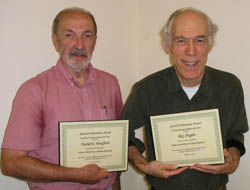 In October 2012, the New England Botanical Club honored David E. Boufford and Ray Angelo with a Special Achievement Award for their long-term and valuable compilation, the Atlas of the Flora of New England. Based on herbarium data and exhaustive research, the Atlas brings together current information on the county-level distribution of plant taxa growing outside of cultivation in the six New England states of the northeastern United States. Dot maps, synonymies, nativity status, and habitat information are also provided for thousands of taxa. The first installment of the Atlas was published in Rhodora in 1996, and publication continues in Phytoneuron and through continual updates. This impressive reference work is extremely useful for botanists interested in the flora of New England and beyond. The Atlas and related documents can be found on our NE Flora webpage.
